

Over the past 100 years, the Winter Olympics have been a spectacle of athletic ability, excellence, and, sometimes, experimentation. Early Olympic organizers often tested new sports by including them as demonstrations – occasionally resulting in the inclusion of anything remotely competitive. As a result, some of the most unusual and unexpected events briefly found a place on the Olympic stage. Here are ten of the strangest demonstration sports ever associated with the Olympic Games:
10. Cycle Polo
Cycle Polo was featured only at the 1908 Summer Olympic Games in London. It followed the same rules as traditional polo, but rather than being mounted on horses, contestants sat on bicycles. According to Topend Sports, the only two teams that participated in this event were the Irish Bicycle Polo Association, and, from Germany, Deutscher Radfahrer Bund. The Irish team ultimately came out on top with a 3-1 victory, making them the only ever Cycle Polo Olympic champions.
9. Gliding
In gliding, contestants sat in sailplanes and used bungees to launch themselves the farthest distance through the air. Though 14 pilots from 7 countries flew, there was no competition, seeing as it was just a demonstration of aeronautic skill. Surprisingly, the sport was approved after its success at the 1936 Berlin Olympics and was set to debut as an official sport at the following Games in Tokyo. Efforts were made to legitimize the sport in preparation, like the designing of the DFS Olympia Meise plane. Unfortunately, the 1940 Tokyo Games ended up being canceled due to World War II, and gliding was never offered another chance on the Olympic stage.
8. Skijoring
The Olympics defines Skijoring as “a sport in which competitors wear skis and clutch reins attached to a wooden harness fitted onto one or more horses, ponies, or dogs.” It was included in the 1928 Olympics in Saint Moritz, Switzerland. The race took place around an oval track on a frozen lake, with horses selected to do the pulling. Rudolf Wettstein, Bibi Torriani, and Henryk Mückenbrunn won Switzerland a clean sweep, earning gold, silver, and bronze, respectively.
7. Ski Ballet
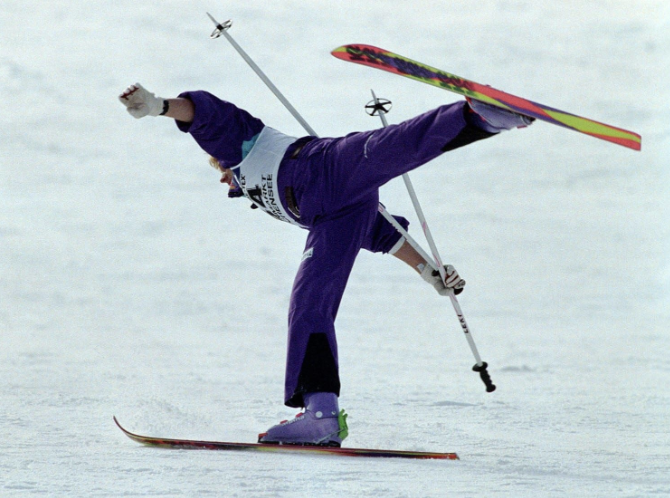
Ski ballet, also referred to as acroski, was a demonstration sport featured at the 1988 Calgary Games and the 1992 Albertville Games. Described as a “lost art” by NBC, it featured contestants who would perform 2-minute choreographed routines set to music, attempting flips and spins on skis. Ski ballet was reportedly a fan-favorite among those attending the Olympics and would attract large crowds due to its theatrical nature. The last winners – in 1992 – were Fabrice Becker of France for males, and Conny Kissling of Switzerland for females, as it never ended up being developed into a true Olympic discipline.
6. Kite Flying
Kite flying was featured as a demonstration at the 1900 Paris Olympics, and was divided into two categories. The first category was a competition of altitude, measured through recorders attached to the kites. The second category required the kites to remain in the air for two hours with 200 meters of cable, and ranked contestants by the maintenance of a steady angle to the ground. Each contestant’s kite was either placed into the small, medium, or large category, with much of the small category consisting of toy kites flown by children.
5. Ballooning
The ballooning demonstration at the 1900 Paris Games was judged subjectively, testing who could fly the farthest, highest, longest, and land the closest to a target while piloting a hot air balloon. According to the National Air and Space Museum, all recorded finalists were French, including Henry de la Vaulx, who set world records both for distance (1,925 kilometers) and duration (36 hours).
4. Live Pigeon Shooting
Described in the official 1900 Games report as “très aristocratique," live pigeon shooting remains the only time in Olympic history where animals were purposely killed. Six birds were released 27 meters in front of contestants, with missing two birds being grounds for elimination. The average killed-bird count among the finalists was 19.8 birds, and 300 were killed among all contestants. To the surprise of no one, the event was extremely “messy,” with “dead or injured birds on the ground and blood and feathers all over the place.” The winner was offered 20,000 Francs, but the finalists agreed to split the cash prize equally.
3. Pigeon Racing
Though it was also held at the 1900 Olympics, pigeon racing was in no way related to live pigeon shooting. This event tested how far pigeons selected from different regions of France could travel, for the purposes of military and communication rather than pure competition. All teams were obligated to release 100 pigeons. Though information is limited, the 1900 Olympic Games Official Report states that 7,721 pigeons were released from 48 teams.
2. Firefighting
As part of the 1900 Paris Games, teams of both volunteer and professional firefighters were evaluated on speed and technique while extinguishing a fire and performing a rescue. The competition was held in a fire simulation in a six-story house, where teams had to climb the building and navigate impassable stairs to ultimately reach the “victims.” A team from Oporto, Portugal, took home the gold in the volunteer division, while Team Kansas City of the United States earned the professional division gold.
1. Plunge for Distance
The St. Louis Olympics in 1904 featured the plunge for distance event, or, as described by BBC, “the lamest, weirdest and most boring Olympic sport of all time.” In plunge for distance, contenders would perform a simple standing dive into water from a low height, and then remain completely motionless for as long as possible. Swimming was strictly forbidden, as it was a test of how far you could glide using the momentum from your dive. The sport was heavily criticized, as from a spectator's view, it appeared to be people floating slowly with no visible movement. However, despite contrasting the athletic action of other Olympic sports, it required an advanced understanding of body positioning to control drag and glide. Unfortunately, according to The Washington Post, it was never able to earn a reputation beyond “competitive floating,” leading to its immediate removal from the Olympic Games.
Unusual demonstration sports offer modern-day viewers a glimpse into the most experimental chapters of the Games, where not all ideas were built to last. While the above events were ultimately benched by the Olympics and never became official, they exist as reminders that even the world’s biggest stage had to figure itself out.