

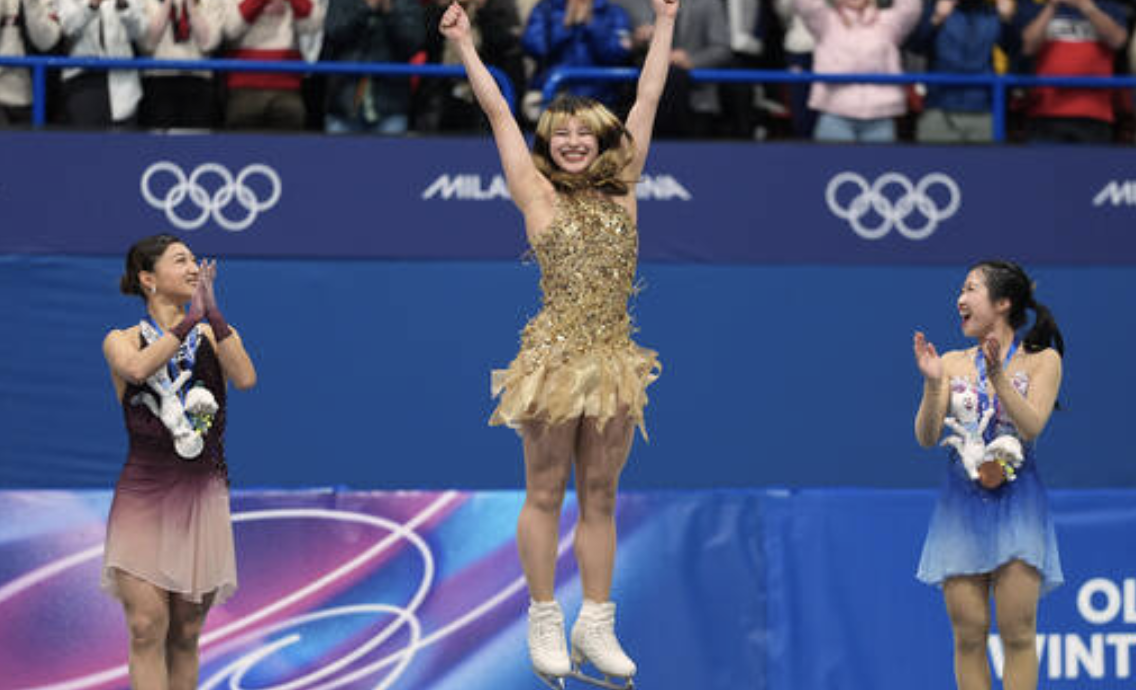
When Alysa Liu secured the women's singles gold medal at the 2026 Olympics in Milano-Cortina, her reaction said as much as her performance. Instead of celebrating alone, she turned immediately to Ami Nakai, embracing her and congratulating the 17-year-old on earning her first Olympic medal.
In a sport often marked by intense pressure and individual rivalry, her instinct to share the moment with her Japanese competitor revealed a rare example of sportsmanship. Liu’s Olympic win comes at a time when a new generation of American skaters is reshaping the culture of the sport – emphasizing authentic support alongside competitive excellence. At the center of that shift is none other than Alysa Liu herself, whose journey, values, and leadership on and off the ice signal a new era for U.S. women’s figure skating.
Liu’s path to Olympic Gold in figure skating has been nothing short of extraordinary. Raised in the San Francisco Bay Area, she began skating at age 5 after her father, Arthur Liu, introduced her to the sport. Arthur Liu immigrated to the United States from China after participating in pro-democracy protests during the Tiananmen Square movement in 1989 and later became an immigration attorney. Including Alysa, he raised five children as a single parent and played a central role in shaping her skating career.
Even at a young age, Liu was considered a prodigy. At just 13, she became the youngest U.S. national champion in history, gaining attention specifically for her technical ability. However, the pressure surrounding Alysa’s training led to burnout and overbearing expectations. Looking back, she recalls the intensity of training as a teenager. In a Rolling Stone interview, she said, “I blocked [the memories] out, for sure. Every time I see a clip of it, it's like I’m watching a movie–I know that's me, but I’m seeing what everyone else is seeing. Every day was the same for me, and practice was so serious. I would cry after falling on every jump; the team I had around me was so strict. I was in fight or flight mode all the time.”
After competing at the 2022 Olympics at 16 and winning a bronze medal at the World Championships that same year, Liu chose to step away from competitive skating without consulting her father. In a world where COVID restricted most people, the pandemic allowed her to step outside of the bubble that was her young skating career for the very first time. During her break, she traveled, attended college at UCLA, and experienced a more typical young adulthood. However, this reprieve was short lived. After a skiing trip in 2024, she felt a surge of adrenaline she had only otherwise experienced during skating. Following this realization, she went to a public ice rink, immediately landed a triple jump, and called up her old coach.
When Liu returned to competition, her approach had changed. With greater independence in her training and decisions, she skated for her own enjoyment rather than external validation. “I get to pick my own program music. I get to help with the creative process of the program,” she said. “If I feel like I'm skating too much, I'll back down. If I feel like I'm not skating enough, I'll ramp it up. No one's going to starve me, tell me what I can and can't eat.” In an interview for 60 Minutes, she described skating as starting to feel more like an art than just a sport: “I view competitions more as, like, a stage for performing.” That perspective was visible in Milano-Cortina, both in her expressive programs and in the humility she showed after winning.
Her life off the ice also shows a broader awareness of the world around her, showing a willingness to engage with social issues affecting her generation. In a clip that surfaced following her Milano-Cortina performance, she expresses, “There’s so many protests that are going on and I’ve attended. Coming from a family of immigrants, I think immigrants deserve rights.” That involvement, alongside her skating career, reflects a growing trend among young athletes who are extending their impact beyond competition.
Part of what makes Liu stand out is her personality. Off the ice, she embraces an alternative style and a relaxed, almost carefree confidence that contrasts with the polished image traditionally associated with elite figure skating. Rather than carefully curated, her presence feels grounded and expressive, reflecting a generation that is rejecting expectations and defining success on their own terms.
That individuality is also shown most evidently in her music choices. Throughout this season, Liu has stepped away from the classical-heavy programs long affiliated with women’s figure skating, instead performing to artists like Laufey, Donna Summer, Joji, and PinkPantheress. This range, from jazz influenced ballads to disco and contemporary pop, shows her willingness to bring her own taste onto the ice.
These unconventional selections make her programs feel personal instead of the ones ‘prescribed’ to her in her early career. Her performances combine technical precision with a sense of freedom, reinforcing her view of skating as a form of connection."It's really the journey that I think is the coolest, to be honest. I don't want this to overshadow my story.” she shared in an NBC interview.
Liu’s mindset reveals a broader change among a group of American women sometimes referred to as the “Blade Angels,” which includes Amber Glenn and Isabeau Levito. Together, the three skaters represent a generation defined by visible camaraderie and openness – something rarely seen before in the sport.
Glenn, in particular, has become one of the most prominent voices for LGBTQ+ representation in figure skating. The first openly queer woman to represent the U.S. in Olympic singles figure skating, Glenn has spoken openly about her identity and advocated for greater inclusion in the sport, using her platform to discuss visibility, acceptance, and mental health. Her advocacy has taken place during a period of heightened national debate over LGBTQ+ rights in the United States, bringing additional attention and appreciation to her willingness to speak out and helping create space for broader conversations within the skating world.
At just 18 years old, Isabeau Levito is one of the younger competitors performing on the Olympic stage. Levito represents the next generation of talent, combining strong technical performances with a growing presence. Known for her balletic style, she has developed a large following on social media for her candid personality and playful humor, often sharing behind the scenes moments from competitions and training to taking care of her plants and plushies. While comparatively newer to the spotlight, she reflects the same culture of support and shared success that defines this group.
Alysa Liu’s gold medal at the 2026 Milano-Cortina Olympics will be remembered as a historic achievement for U.S. women’s figure skating, but its meaning extends far beyond the win. Her instinct to celebrate with a competitor captured the values shaping a new era of U.S. women's figure skating: one based on authenticity. Alongside the Blade Angels, Liu represents a generation that is redefining the sport’s culture, going against silence in favor of expression and mutual support.
This change is notable in relaxed press conferences, Gen-Z social media humor, and athletes who speak openly about advocacy and identity. Figure skating is no longer about perfection on the ice, but about their presence off of it, including who skaters are and how they treat one another.
What this team represents points toward a future where excellence is surrounded by community and the courage to be fully oneself. In a sport once defined by rivalry and expectations, Liu’s embrace of Ami Nakai was both a celebration and a symbol of change.