


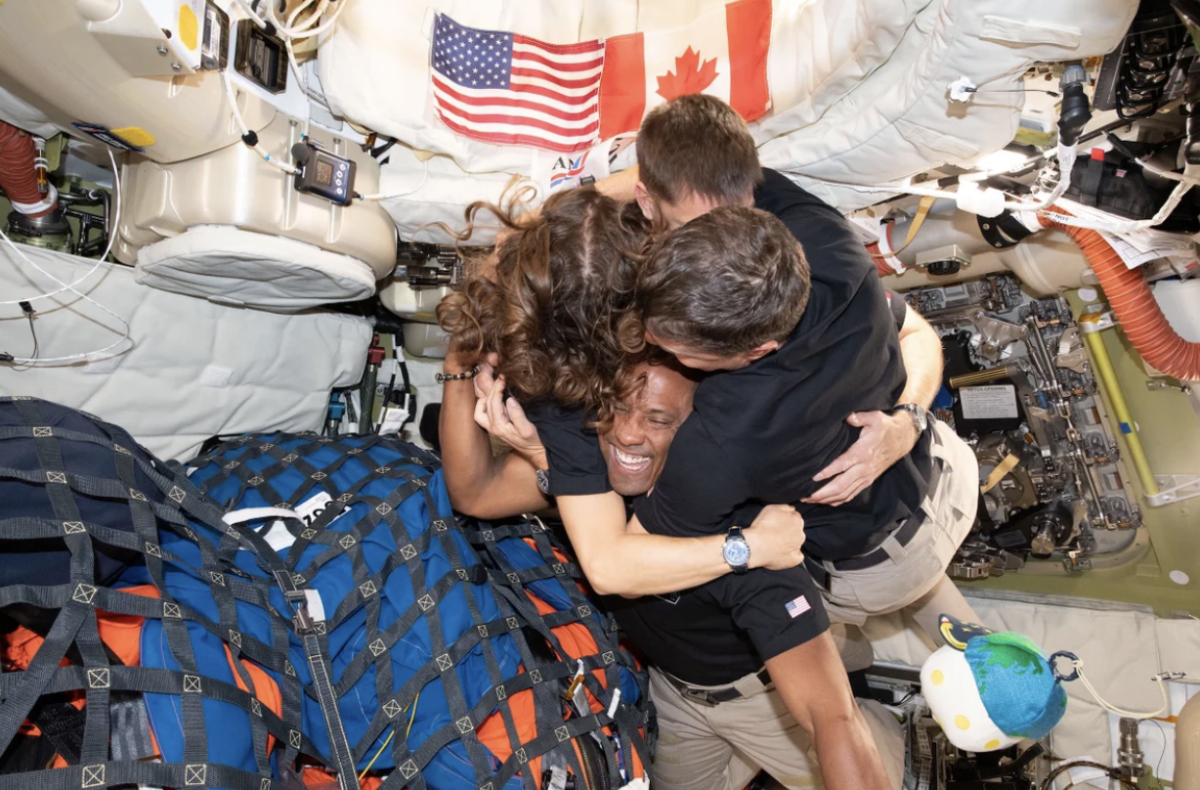
In April 2026, four astronauts flew farther from Earth than any humans had ever before, drawing a level of attention few scientific missions do today. This flight is part of a larger effort led by NASA to return humans to the moon for the first time since the Apollo era. Artemis II, a 10-day journey looping around the moon and back, marks the first crewed test of that plan. It lays the groundwork for future landings and longer-term projects, including building a sustained presence on the lunar surface and eventually pushing towards Mars.
While on paper it may seem like a technical mission, the crew – Christina Koch, Victor Glober, Jeremy Hansen, and Commander Reid Wiseman – made the experience much more personal. Their presence marked several firsts: Koch became the first woman to travel around the moon’s far side, and Glover the first Black man. Hansen, representing Canada, was the first non-American to travel beyond low Earth orbit. The Artemis II crew, therefore, represents a version of space exploration that feels more inclusive than ever before; together, they became the first humans in over 50 years to see the moon’s “dark side,” while allowing people across the world to see themselves in a story marked by community amidst the unknown.
Even so, the astronauts themselves don’t seem to focus as much on the personal milestones. Koch reflected on a conversation she had about these records with Apollo 13 astronaut Fred Haise, emphasizing that “when we talk about superlatives, we may inadvertently ignore the real story of what’s going on in our mission…It’s about the teamwork and the work that went into that.” That perspective shows up in how the crew described the experience overall, focusing most on what they were learning and feeling, as well as those involved beyond the four on board.
For us fans who stayed on Earth during the 10-day flyby, the most memorable moments came from more personal choices. During the mission, the crew named a bright lunar feature after Carroll, Wiseman's late wife, who passed away from cancer in 2020. Though isolated 252,756 miles from our planet, the four carried memories from back home with them on their journey. Rather than processing just data, they interpreted what they saw through meaning and emotion, embodying the core values represented by their spacecraft capsule, Integrity.
These touching moments were paired with smaller glimpses of their daily life in space which many viewers tuned in to watch through the official NASA livestream. The crew shared playlists including a range of tracks, from Chappell Roan’s Pink Pony Club to Under Pressure by Queen and David Bowie.
The crew also brought small personal items with them, including mementos tied to earlier chapters of space exploration. Among them were items and hardware tied to Space Shuttle Challenger and Columbia missions that ended in tragedy, carried in honor of the astronauts who lost their lives. This emphasized the sense that exploration builds on the past as much as the future, and that those who came before are still part of the journey in some form.
The crew’s predecessors stayed on that journey until the end: during a welcome-back event following the successful completion of the Artemis II mission, Wiseman honored the legacy of the 1972 Apollo 17 mission, revealing a worn patch given to his flight instructor by Apollo 17 commander Gene Cernan 20 years prior with instructions to pass it on when humanity returned to the moon. 50 years later, Wiseman was able to address Cernan's legacy, saying, “Gene, we made it. And we're not stopping.” Ultimately, this passing of the torch symbolizes the transition from the legendary Apollo era to the Artemis program’s goal of establishing a sustainable presence on the moon.
Despite their focus on the moon, what the astronauts said about Earth ended up shaping how many people understood the mission. Looking back from that distance, Koch described seeing Earth as a “lifeboat hanging undisturbedly in the universe,” emphasizing how small it appeared when surrounded by the vast emptiness of space. That reaction connects to what is known as the “Overview Effect,” a shift in perspective that astronauts experience when seeing Earth as a single, borderless whole. As Koch put it,
“When you look down at Earth from space, you don’t see borders…you see that we are way more alike than we are different.” Glover added a similar reflection: “From up here, you also look like one thing; Homo sapiens is all of us. No matter where you're from or what you look like — we're all one people.”
That shared perspective extended beyond the crew to the people watching on Earth. The attention surrounding Artemis II reflected what sociologists call “collective effervescence,” a moment when large numbers of people feel the same emotion at the same time. Livestreams and shared public reactions created a feeling of global participation, even from such a distance. Ultimately, in a media landscape that is usually fragmented, this collective focus is increasingly rare. For a brief moment, it brings people together under a shared sense of wonder.
This mission also reveals a broader shift in how space exploration is perceived. In the 20th century, the race to the moon was framed by Cold War competition. Artemis II takes place in a different context where international cooperation is essential and missions depend on partnerships between countries and organizations. The emphasis has changed towards cooperation instead of dominance.
Artemis II is still part of a larger process. The data gathered on speed, space radiation exposure, and navigation will guide future missions, including planned lunar landings and longer-term habitation. Its technical role is essential, but its impact goes further than a demonstration of capability. As global conversation is being frequently defined by division, Artemis II left behind a united image of Earth while showing that space travel is a human project grounded in human connection.