

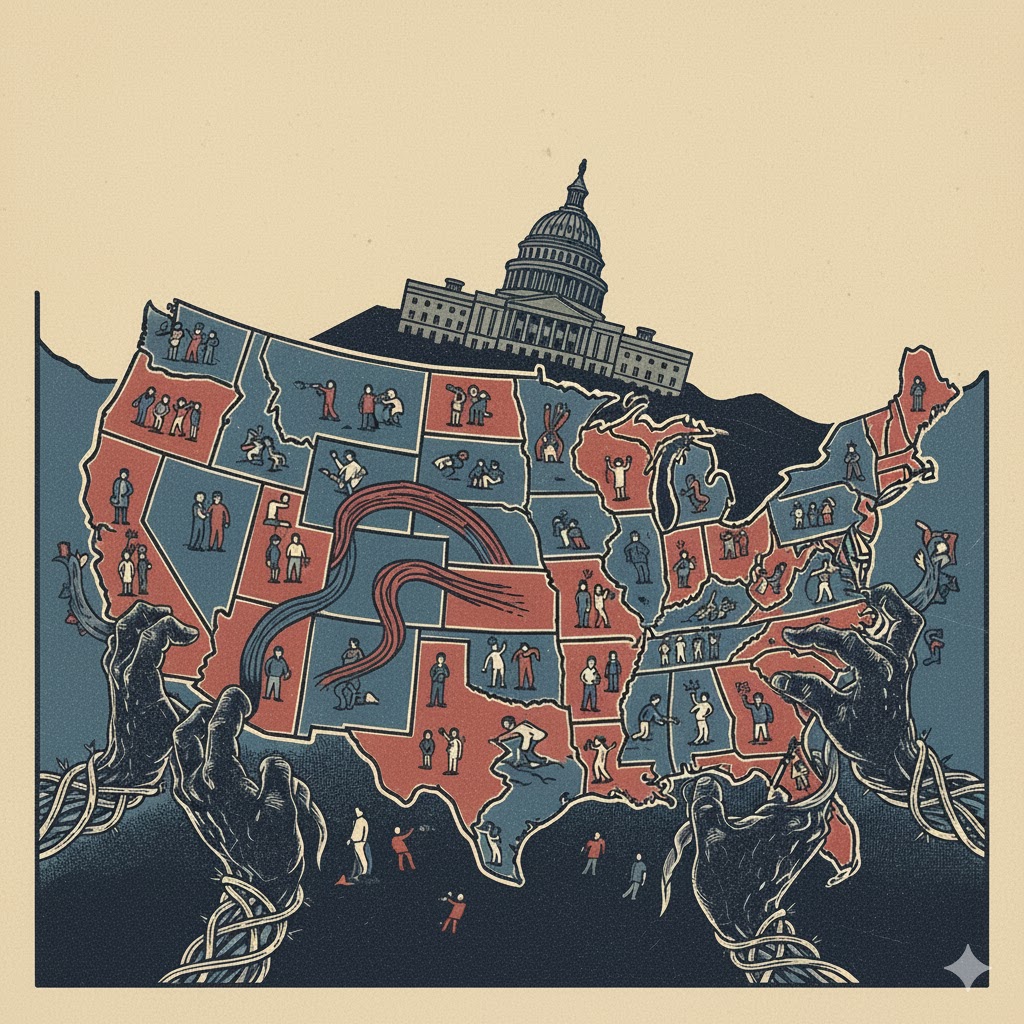
We live in one of the most politically polarizing times in American history. One look at the current makeup of our congressional delegations shows how problematic this current style of government is. In the current system, states controlled by both parties have designed their congressional maps to favor the party they are affiliated with. One example of this is Oklahoma.
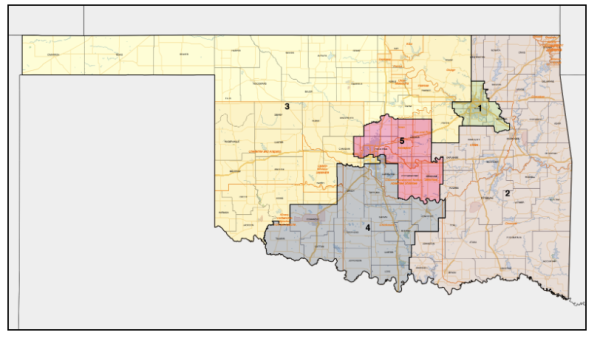 Oklahoma has five congressional districts and votes around one-third Democratic. However, all five of Oklahoma’s congressional districts are controlled by Republicans. This means that Oklahoma Democrats, who tend to be socially moderate and fiscally progressive, are underrepresented in Congress. The same is true for Arkansas, which votes closer to 40% Democratic but has 4 Republican districts.
A more accurate representation in Arkansas’s case would be three Republican districts and one Democratic district. And in Oklahoma’s case, three Republican and two Democratic districts. Massachusetts and Connecticut are very similar. More than a third of their population votes Republican, but those Northeastern Republicans, who tend to be more socially moderate and fiscally conservative, have zero representation in Congress.
This could be chalked up simply to gerrymandering. However, Oklahoma and Massachusetts are among the only states that, in the last Presidential election, had their counties vote unanimously for one party or another. That means, regardless of map-drawing, the most each state could generate in democratic districts is one. But both are still highly competitive. Instead, to better represent the minority parties in each state, proportional representation is needed.
In general, many systems of proportional representation are used today across the world:
Open List. You vote for a person, and your vote counts toward the party’s total. The party total determines how many seats each party gets. And the seats go to the people from each party who got the most votes.
Closed List: You only vote for a party in a closed list system. Each party gets a certain percentage, which decides the number of seats. The people who fill seats come off a party’s list, which voters have no say in.
Mixed Member Proportional: Under this system, you vote twice, once for a party and once for a candidate. Each district elects one person to represent it. These constituency representatives fill some seats in the legislature. However, the remaining seats are determined by party vote, and the result is the division of additional seats based on the national or statewide party vote.
First Person Transferable Vote (ranked choice): You rank multiple candidates based on your liking. It encourages voters to choose minor candidates. If your first choice is unpopular, then they use your second choice, and so on, until a threshold is reached. And if you lower the voter threshold in ranked-choice voting, that produces multiple winners and is more proportional to the votes.
I believe the most effective approach is a First-Person Transferable vote mixed with an Open List system. In this system, you rank multiple parties by preference, then rank candidates from each party. The number of seats is determined by this party’s vote ranking and tally, and the people who fill the seats come from that party’s ranked list of candidates.
However, having multiple representatives per district requires changing the way Congress is formatted. Currently, there are 435 members of the House of Representatives, each representing one district. To have multiple representatives per district, Congress would need to become larger. Expanding the membership would mean reducing the number of districts.
Political scientists suggest that the number of representatives in both chambers of a legislature should be the cube root of the population they represent. As such, the cube root of 335 million is 693. The Senate, which requires 2 Senators per state and 50 states, has 100 members. If you subtract them, you get 593.
The New York Times recently argued for reducing the number of districts so that each district has multiple representatives. In this system, they suggest, districts in each state could reasonably get up to 9 representatives. Consequently, the House would have 119 districts.
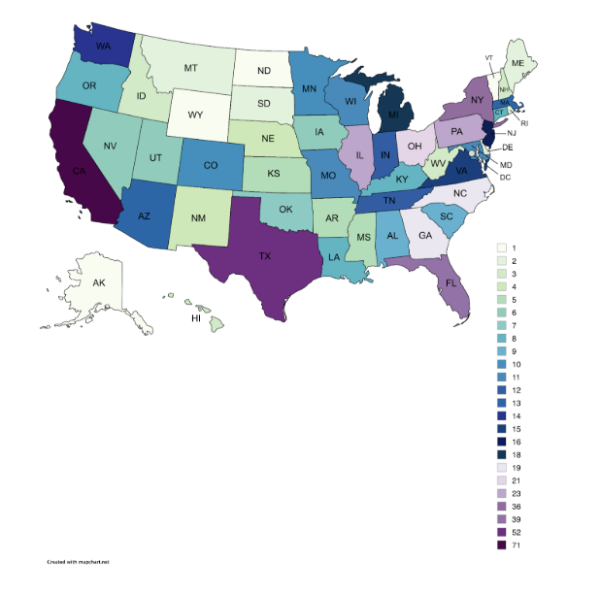
We here at UNISVerse calculated the number of representatives to be allocated per state. Above is a map of allocated seats based on each state’s population, with the smallest states—Wyoming, Vermont, and North Dakota —each getting one seat, and California, with 71 districts, having the most seats.
This new structure would not only more fairly reflect the political diversity within states but also give voice to minority parties that are currently denied representation. By embracing proportional representation, the United States could move beyond the distortions of gerrymandering and geographic imbalance, and toward a system that honors the full range of its citizens’ beliefs. In a time of extreme polarization, reforming how we elect our leaders is not just a policy proposal—it’s a democratic necessity. Only through such systemic change can we ensure that Congress truly looks like America —not only in terms of race and party preference, but also in income background. This would make it easier for lesser-funded candidates to win elections. Coupling this with reforms to campaign finance law and term limits could ensure a more democratic Congress that understands the needs of working-class Americans. Overall, this is an important step to fix our broken political system.
Contact your members of Congress and tell them to support already existing legislation from Democratic representatives like Jared Golden of Maine and Alexandria Ocasio-Cortez of New York to ensure our elections are fairer.